ChatGPT, Gemini & Google AI Overviews Don't Cite Websites the Same Way

Oblix Digital
Web design & SEO
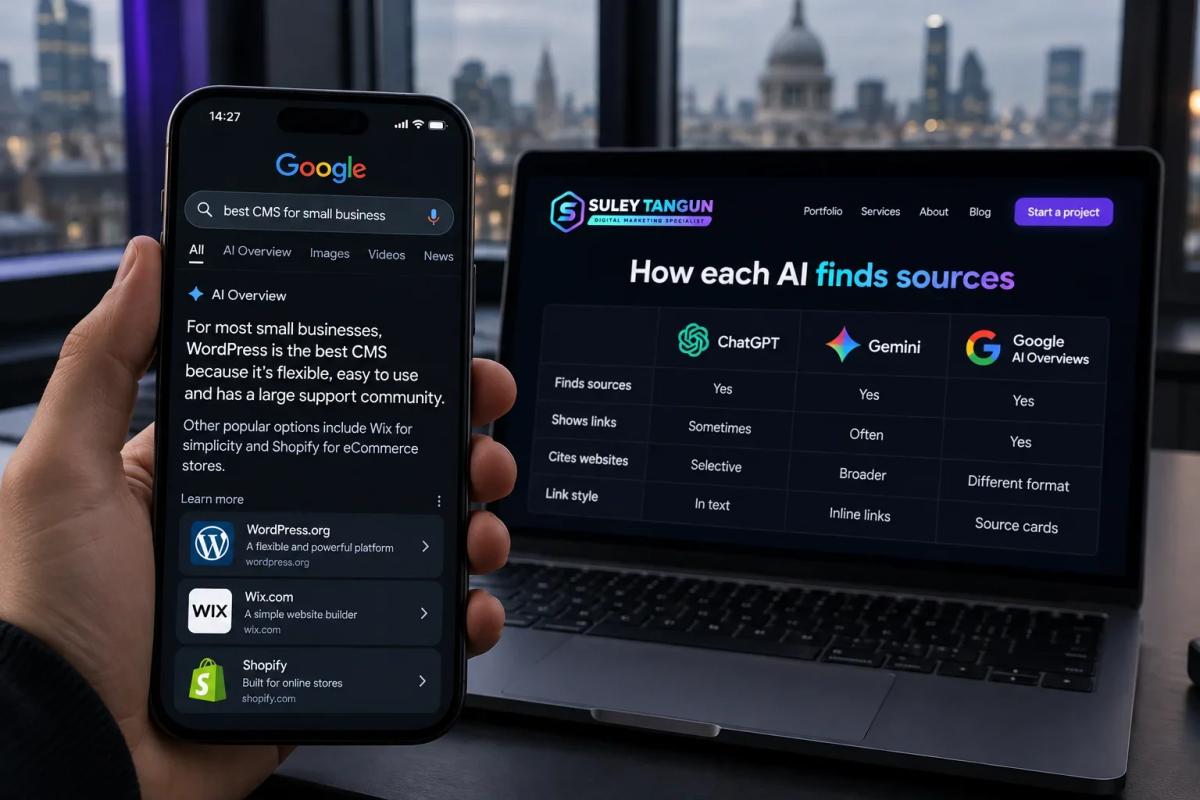
It is tempting to treat getting cited by AI as one job with one checklist, but ChatGPT, Gemini and Google's AI Overviews do not find and choose their sources in the same way. Knowing where each gets its information shows which parts of your existing work already help, and where the gaps are.
Google AI Overviews are built on Google's normal index
AI Overviews are not a separate system with separate rules. They link to pages from Google's normal search index, and Google's guidance is that a page must be indexed and eligible to appear as a normal search snippet before it can be shown as a supporting link. If Google already crawls, understands and ranks your pages for relevant searches, you are most of the way there. If it does not, no AI-specific trick gets around that.
Google also says its AI features may run several related searches across different parts of a question, a method it calls "query fan-out", and link to a wider mix of pages as a result. A clear page that answers one part of a bigger question well could be enough to get you included.
Gemini sits on the same side of the fence
Gemini is Google's own model, and when it needs current information it grounds its answers in Google Search. The same foundations apply: being indexed, being understood and having a page that answers the question clearly. The technical SEO work you do for Google serves both AI Overviews and Gemini.
One setting to check: if your robots.txt file blocks "Google-Extended" to opt out of Gemini training, Google says that also stops your pages being used to ground Gemini's answers. It does not affect your place in normal Google Search.
ChatGPT works from two different sources
ChatGPT combines two things. One is what the model learned in training, a snapshot of the web up to a cutoff date that is not updated live, so recent changes to your site may not be in it. OpenAI lists the knowledge cutoff for its GPT-5 model, for example, as 30 September 2024. The other is live web search, which it uses for some questions to fetch and cite current pages. Which one shapes an answer depends on the question, which is partly why the same query can produce different answers from one week to the next.
Why that changes your priorities for chat-first tools
Because the trained knowledge comes from a broad cross-section of the web rather than one search index, what other sites say about you carries more weight: reviews, directory listings, local press and industry sites. On the live-search side, freshness matters, and so does whether these tools are allowed to fetch your pages. Check that your robots.txt file, the plain-text file that tells crawlers what they can access, is not blocking AI search crawlers by accident. Since 1 July 2025, for example, Cloudflare has blocked AI crawlers by default on new domains unless the owner allows them.
Where I'd put the effort
- For AI Overviews and Gemini: get the technical SEO right first, meaning clean indexing, fast pages and clear structure, because it is the same foundation.
- For ChatGPT and similar tools: keep key pages up to date and build a consistent presence on reputable sites beyond your own.
- For all of them: make sure the crawlers can reach the pages you want cited.
These products change quickly, so treat this as how things work today rather than a permanent rulebook. If you would like to know where your site stands across all three, get in touch and I'll take a proper look.
If you would rather use AI inside your own business, for content, admin or customer enquiries, see AI for Business.
This is my own opinion, based on what I have seen work in practice, and not legal, financial or professional advice. Every business is different, so take advice on your own situation before making a decision. Views are my own and not those of my employer.
Sources
- Google Search Central: AI features and your website
- Google: Common crawlers (Google-Extended)
- OpenAI: Overview of OpenAI crawlers
- OpenAI: GPT-5 model page
- Cloudflare: Cloudflare just changed how AI crawlers scrape the internet at large (July 2025)
Related reading
Frequently asked questions
Do I need separate SEO for Google AI Overviews?
No. AI Overviews draw on Google's normal search index and ranking systems, and a page needs to be indexed and eligible to show as a standard search result before it can be used as a supporting link. Solid traditional SEO is the foundation.
Why doesn't ChatGPT know about recent changes to my website?
Part of what ChatGPT knows comes from its training data, a snapshot of the web up to a cutoff date that is not updated live. It only sees recent changes when it runs a live web search for a particular question, so newer information can take time to appear consistently.
Could my website be blocking AI tools without me knowing?
Yes. Your robots.txt file and some hosting or security settings can block AI crawlers. Cloudflare, for example, has blocked AI crawlers by default on new domains since 1 July 2025. Check which crawlers are allowed so the tools you want to be cited by can reach your pages.
Is Gemini closer to Google Search or to ChatGPT?
Closer to Google Search. Gemini is Google's own model and grounds its answers in Google Search when it needs current information, so the indexing and technical SEO work that helps with AI Overviews also helps with Gemini.