Your Competitors Can Now Advertise Inside ChatGPT: What It Means for You

Suley Tangun
Digital Marketing Specialist
Published · 11 min read
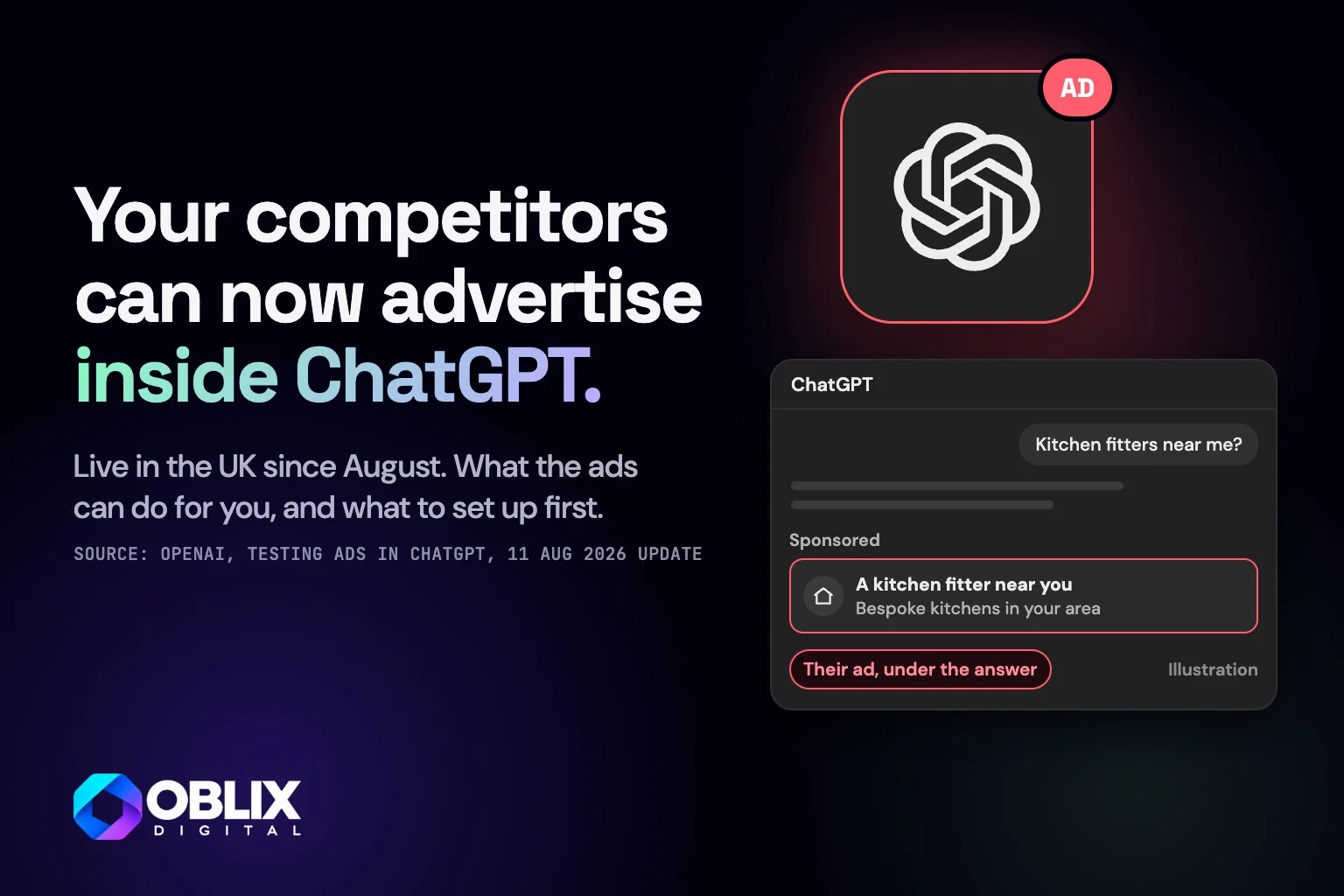
Since August 2026, ChatGPT has been showing ads to people in the UK, and UK businesses can now buy them through OpenAI's own Ads Manager. That means a competitor could appear under ChatGPT's answer when someone asks who fits kitchens, fixes boilers or does accounts in your area.
I've been through OpenAI's own help pages so you don't have to. This guide covers what the ads are, whether you can buy them, what they can do for a small business, how to start on a small budget and what to set up on your website before you spend anything.
Swipe or scroll through, and tap a slide to see it larger
The bottom line
- What ChatGPT ads are
- One labelled ad under ChatGPT's reply, shown to people on the Free and Go plans
- Who can buy them
- UK businesses, through OpenAI's self-service Ads Manager, from £15 a day
- What to do
- Check your landing page, test your enquiry form and set up tracking before your first campaign
- Conclusion
- Worth a small, measured test for many local businesses, once the website is ready
What ChatGPT ads are
A ChatGPT ad is a sponsored placement that appears below ChatGPT's reply. It's clearly labelled, and it shows your business name, your logo, a headline, a short description, an image and a link to a page on your website. People see one ad unit at a time, and OpenAI is also testing a format with several images.
The answer stays the same whether you pay or not. OpenAI says ads run on separate systems from the chat model, and advertisers can't shape, rank or change ChatGPT's responses. What you're buying is a visit to your website, which is why the page that visit lands on matters so much.
Ads only show to people on the Free and Go plans. Anyone on Plus, Pro, Business, Enterprise or Edu doesn't see them, and nor do accounts OpenAI identifies as belonging to under-18s. Advertisers never see anyone's chats; you get totals, such as views and clicks.
Can UK businesses advertise in ChatGPT?
Yes. OpenAI started testing ads in the US in February 2026 and named Canada, Australia and New Zealand as the next markets in March. On 11 August 2026 it said ChatGPT ads had launched in the United Kingdom, along with Mexico, Brazil, Japan and South Korea.
You don't need an agency to get in. OpenAI's Ads Manager availability page lists the United Kingdom as available for self-service, so you can sign up at ads.openai.com with the login you use for ChatGPT. The business that advertises and pays has to be based in a country on that list, and larger advertisers can go through OpenAI's sales team instead. Some new self-serve accounts can only advertise in their home country at first, which is fine if your customers are in the UK.
What ChatGPT ads can do for a small business
Google Ads works on keywords: you pick the searches you want to appear for. ChatGPT reads the conversation, the ad and the page it links to, then decides whether your ad is relevant. You help it with context hints, which are short plain-English descriptions of your service, who it's for and when it's useful.
Take White Buffalo Bespoke, a North London builder whose website I built. The ad in the slides above is an illustration I mocked up, not a live campaign. A hint for its kitchen ads might read "Bespoke kitchen design and installation for homeowners in London and the Home Counties". OpenAI is clear that hints guide the match but don't guarantee your ad appears in a particular conversation, and they aren't targeting rules.
Targeting is where it gets useful for local firms. You choose the countries a campaign runs in, and for most campaigns you can narrow that to regions, cities and postcodes where OpenAI supports them. You can also pick devices, such as the iOS or Android app or desktop web. Larger businesses can upload customer lists, but these need at least 25,000 matched people before you can target them.
Why it's worth considering, and how to start small
OpenAI's pitch is that people use ChatGPT to explore options, compare choices and make decisions. That's the moment a local business wants to be seen. It's also a new channel, so a small test now tells you whether it suits your business before you decide on anything bigger.
You stay in control of the spend. You can pay per 1,000 views, pay per click, or let OpenAI aim for conversions such as enquiries (you're still billed per click or per view, not per enquiry). In the UK the minimum daily budget is £15. A daily budget is an average over a week, so one day can spend up to twice that, but a week never goes over seven times it. OpenAI's guide suggests starting with a maximum bid of $3 to $5 per click; that figure is in US dollars, so treat it as a rough starting point.
Ads Manager reports impressions, clicks, spend, click-through rate, average cost per click and conversions. What it can't give you yet is a benchmark: OpenAI says there are no performance benchmarks across advertisers or industries so far. One early academic study of online shops found that, in US traffic, a paid ChatGPT visit brought in less revenue than a paid Google Search visit. It's a preprint about online retail, still under review, so I wouldn't read much into it for a UK service business, but it's another reason to start small and judge the results on your own enquiries.
What to have in place before you spend
Most of the work happens on your website, and it's the same work that makes Google Ads pay. Before a first campaign, I'd check these four things.
- A landing page OpenAI can open. Every ad is reviewed before it runs, and OpenAI's crawler, OAI-AdsBot, visits the page your ad links to. If your robots.txt file (the file that tells bots what they may visit), firewall or bot protection blocks it, the ad can be held up. OpenAI also recommends allowing OAI-SearchBot.
- The right page for each ad. Link to the page about the service in the ad, such as your kitchens page, rather than your homepage. OpenAI's own advice says the same.
- An enquiry form you've tested. Fill it in yourself on a mobile, send it and check the email arrives where you expect.
- Enquiries that get counted. OpenAI's pixel or its Conversions API reports enquiries back to Ads Manager, and UTM tags (labels added to the end of your ad link) show ChatGPT visits in Google Analytics. Without one of these, you're judging the ads on clicks alone.
I've written more about these checks in why Google Ads don't get leads and what to check when a website gets no enquiries. The same fixes apply here.
When ChatGPT ads may not suit you
Ads aren't shown near sensitive topics such as personal health, mental health and politics, and political ads aren't allowed. Health and financial services firms can only advertise if they meet OpenAI's stricter rules. And if most of your customers pay for ChatGPT Plus or use it through work on a Business plan, they won't see your ads at all.
You can also be mentioned in ChatGPT's answers without paying. That comes from clear service pages, consistent business details and real reviews, which I cover in how to get your business mentioned in ChatGPT.
One last thought
ChatGPT ads put you in front of someone at the point they're weighing up who to hire. For most small businesses the sensible order is website first, tracking second, then a small test with a budget you're happy to learn with. If you'd like a second pair of eyes on your landing page or tracking before you start, get in touch and I'll tell you honestly whether it's ready.
This is general information, accurate as of 19 November 2026. ChatGPT ads are still in beta, so check OpenAI's pages before you plan a campaign.
Sources (12)
- OpenAI: Testing ads in ChatGPT. Updates of 26 March and 11 August 2026 (UK launch), plans that see ads, answer independence and privacy. Checked 19 November 2026.
- OpenAI Help Centre: Ads in ChatGPT, The Basics. Ad format, context hints, pricing, suggested bids and reporting. Checked 19 November 2026.
- OpenAI Help Centre: Ads in ChatGPT. Who sees ads, separate systems, sensitive topics and advertiser data. Checked 19 November 2026.
- OpenAI Help Centre: Ads Manager Availability. United Kingdom listed as available for self-service. Checked 19 November 2026.
- OpenAI Help Centre: Creating campaigns for ChatGPT Ads. Location and device targeting, home-country rule and the £15 GBP minimum daily budget. Checked 19 November 2026.
- OpenAI Help Centre: Writing context hints. Checked 19 November 2026.
- OpenAI Help Centre: Daily budgets. Checked 19 November 2026.
- OpenAI Help Centre: ChatGPT Ads FAQ. Beta status and no benchmarks yet. Checked 19 November 2026.
- OpenAI Help Centre: Allowing OpenAI web crawlers. OAI-AdsBot and landing page checks. Checked 19 November 2026.
- OpenAI Help Centre: Conversion measurement. Pixel and Conversions API. Checked 19 November 2026.
- OpenAI Help Centre: Custom audiences. 25,000 matched users minimum. Checked 19 November 2026.
- Kaiser and Schulze: Can Advertising Fund Free AI? October 2026 preprint on online shops, listed as under review. Checked 19 November 2026.
Frequently asked questions
Can UK businesses advertise on ChatGPT?
Yes. OpenAI launched ChatGPT ads in the UK on 11 August 2026, and its Ads Manager availability page lists the United Kingdom as open for self-service. The business that advertises and pays must be based in a listed country.
How much do ChatGPT ads cost?
You set your own budget and bid. In the UK the minimum daily budget is £15, and you can pay per click or per 1,000 views. OpenAI's guide suggests a starting maximum bid of $3 to $5 per click, given in US dollars.
Does paying for ChatGPT ads change ChatGPT's answers?
No. OpenAI says ads run on separate systems from the chat model, are clearly labelled and sit below the reply. Advertisers can't shape, rank or change ChatGPT's responses.
Who sees ChatGPT ads?
Adults on the Free and Go plans. People on Plus, Pro, Business, Enterprise and Edu don't see ads, nor do accounts identified as under 18, and ads aren't shown near sensitive topics such as health or politics.