Organic vs Paid Social Media: Which Is Right for Your Business?

Oblix Digital
Web design & SEO
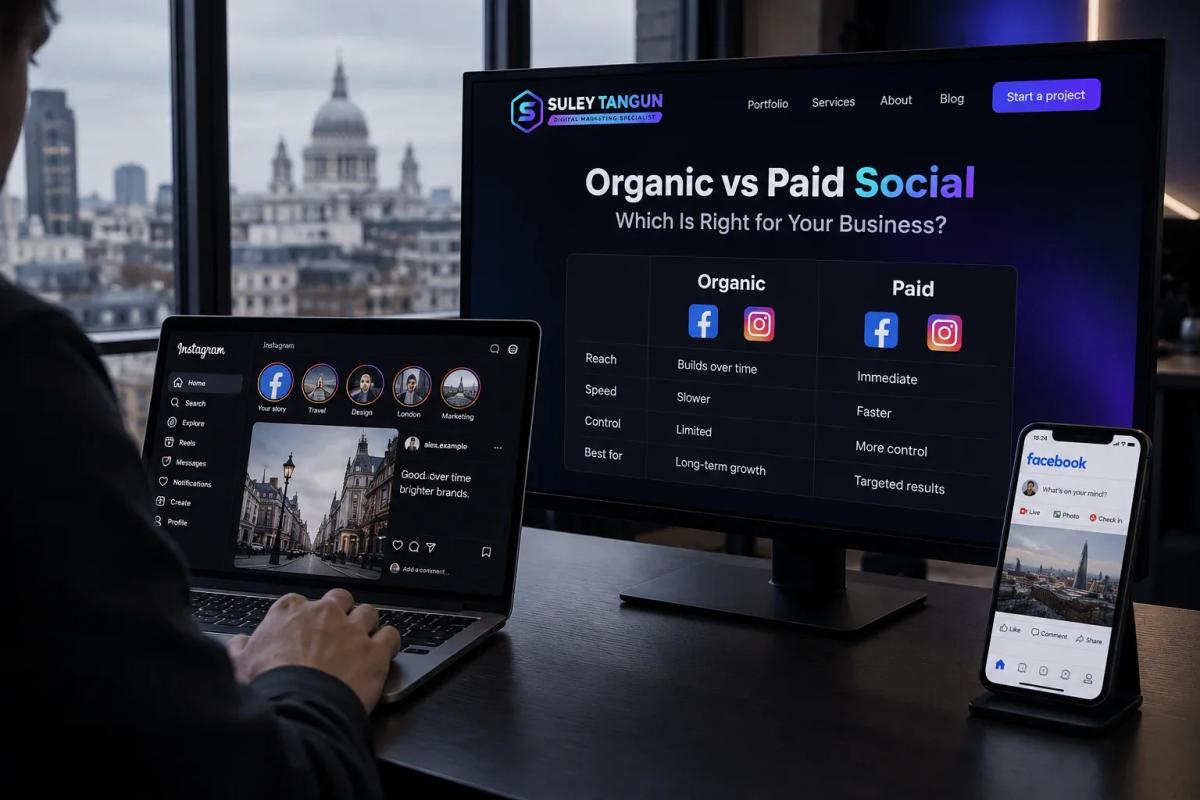
Organic and paid social are often grouped together as "social media marketing", but they work in very different ways. Treating them as the same job is a common reason small businesses feel they are getting nowhere on Instagram or Facebook.
What organic social gets you now
In my experience, organic reach has become harder to come by, and a business page posting regularly without ad spend will often reach only part of its own following. That does not make organic worthless. It is still where trust is built: reviews, behind-the-scenes content and real engagement in the comments, the things that make someone comfortable enough to buy from you.
Think of organic social as your shop window rather than your billboard. People who already know you look at it. Strangers rarely come across it on their own.
What Instagram says about reach
Instagram's own guide to how it ranks posts is worth knowing. It says most of what people see in Reels comes from accounts they don't follow, while Stories show people they already follow, plus ads. So if you want new people to find you, Reels are the better bet.
Instagram also says it shows fewer people Reels that are blurry, carry another app's watermark, such as a TikTok logo, or have already been posted on Instagram, so upload the clean original. It mainly looks at how likely people are to share a Reel, watch it to the end and like it, so keep it short and worth sending on.
If you think you've been shadowbanned, meaning your posts have quietly stopped being shown to new people, check Account Status in the Instagram app first. Instagram says it shows whether your account can be suggested to people who don't follow you, and lets you appeal if it can't.
What paid social is for
Paid social solves the discovery problem that organic cannot. It puts your business in front of people who have never heard of you, targeted by location, age, gender or interests, at a scale organic reach no longer offers. The trade-off is clear: it stops the moment you stop paying.
Before you spend, look at Meta's Ad Library, which lists the active ads any Facebook Page is running. Search a competitor's name to see what they are offering.
A common mistake
Running ads that lead to a profile with nothing behind it: an inactive feed, no reviews, nothing to reassure a stranger that the business is real. Paid social works best when it sends new people towards something organic has already made trustworthy, not when it is compensating for its absence.
Where I'd put a limited budget
- A small, consistent baseline of organic content. Two or three posts a week keeps a profile looking active to anyone who checks it.
- A modest, targeted paid budget behind a specific offer or service, rather than boosting posts at random.
- Real engagement. Replying to comments and messages does more for trust than posting volume.
Neither channel replaces the other. Organic without paid struggles to reach anyone new; paid without organic spends money persuading strangers to trust a business that looks abandoned when they click through.
If email is part of your mix too, the same discipline applies. My email marketing dos and don'ts cover the habits that make a difference.
If you are unsure where your budget should go, that is worth a proper conversation rather than a guess. Social media campaigns are something I plan and run, so get in touch for a frank view of your situation.
Views are my own and not those of my employer.
Sources
Frequently asked questions
Is organic social media dead?
No, but its job has changed. It is no longer a reliable way to be discovered on its own, and works best as a trust-building layer that supports paid activity rather than replacing it.
How much should a small business spend on paid social?
There is no universal figure. Starting small and specific, with a single offer and a defined audience, then scaling what works, is far more sensible than a large, broad budget from day one.
Which platform should I focus on first?
Wherever your customers already spend time, rather than whichever platform is most popular in general. A trades business and a beauty brand can need completely different platforms to get the same result.
Do I need both organic and paid social?
Ideally, yes, even if the split is uneven. A small, consistent organic presence gives a targeted paid budget something credible to point to, which neither achieves alone.