Instagram and Facebook Ads: Are You Paying for Clicks That Never Convert?

Suley Tangun
Digital Marketing Specialist
Published · 9 min read
Advertising on Instagram and Facebook means paying Meta to deliver your message through its advertising system. You choose a business objective, supply the creative, set audience and budget controls, and decide where people should go. Meta then uses its delivery and auction systems to choose eligible opportunities to show the ad.
You are not buying a guaranteed number of customers, and your followers are not the limit of the audience you may reach. The quality of the offer, the people reached and what happens after they respond all affect whether the spend is useful.
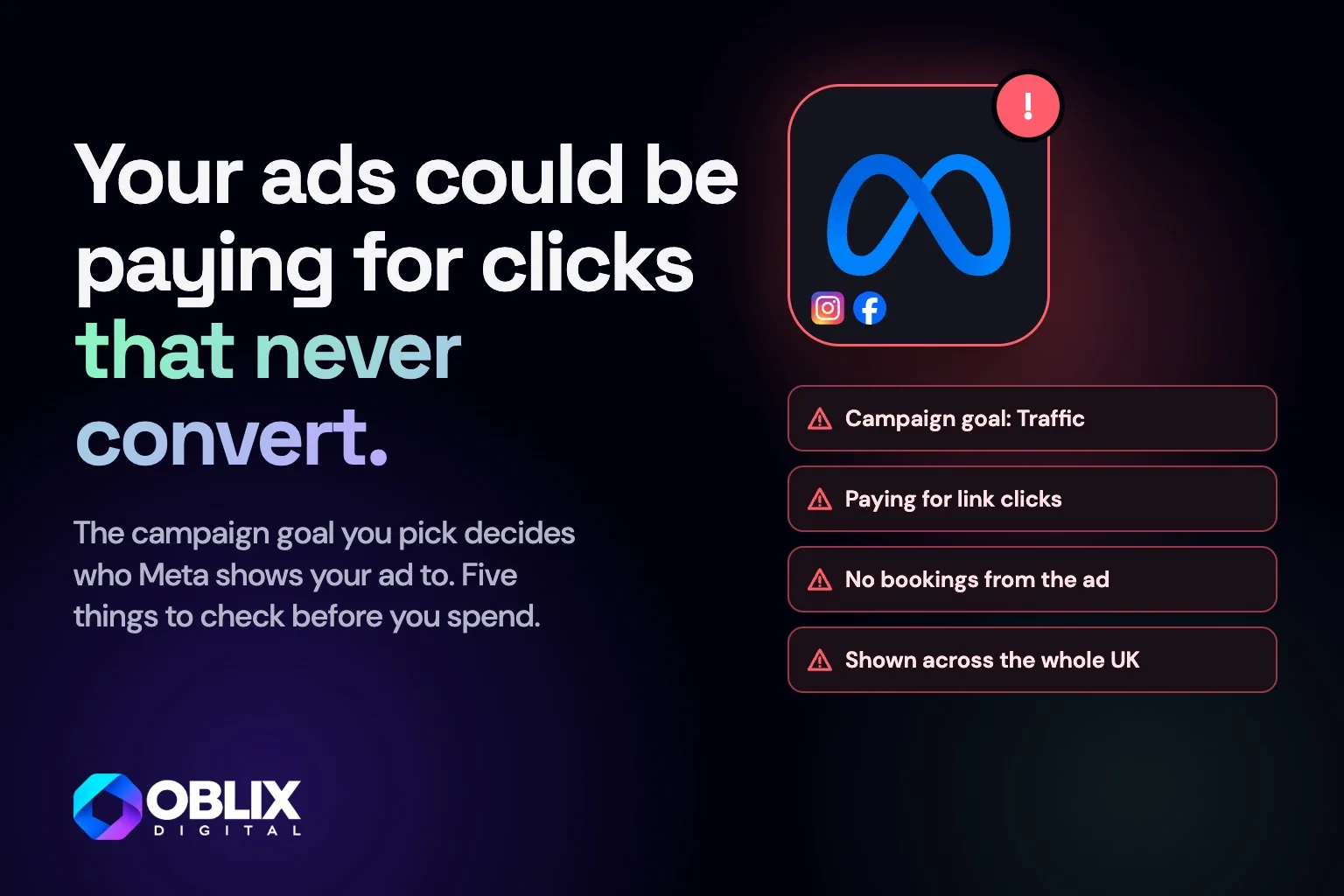
The campaign goal you pick decides who Meta shows your ad to. Five things to check before you spend: the goal, where the budget goes, the ad itself, the area you can serve and how you track bookings.

Swipe or scroll through, and tap a slide to see it larger
1. Set the goal to the result you want
A campaign can be designed around awareness, visits, engagement, leads or sales, with the available setup depending on the account and campaign type. The objective and performance goal influence what the system tries to achieve. If you ask for inexpensive visits, you should not assume you are running the same campaign as one designed to find people likely to complete a lead action.
Meta describes Traffic as sending people to a destination, such as your website, and Leads as collecting leads for your business or brand. Meta looks for the result you ask for: Traffic finds people likely to click, and Leads finds people likely to get in touch. A salon that wants bookings should build the campaign around the booking itself.
Write down the outcome in business language before choosing the controls. A local installer might want relevant survey requests, while an online shop wants purchases with an acceptable acquisition cost. Likes can provide context, but they are not an adequate substitute for either outcome.
2. Check where your budget is going
Think of the campaign as the overall job, the ad set as a delivery setup and the ad as the message people see. Budget can be controlled at different levels depending on the setup, so check where it is allocated rather than assuming each ad gets an equal share. Audiences, placements and optimisation choices also depend on the configuration you select.
This structure matters when reviewing results. Several ads may be competing inside a shared budget, and the platform may give one far more delivery than another. A low-spend ad has not necessarily had a fair performance test merely because it was switched on at the same time. If you want two ads tested fairly, give each its own ad set and budget.
3. Paying more won't save an unclear ad
Meta's published explanation describes an auction considering the bid, estimated likelihood of the desired action and ad quality. In simple terms, willingness to pay is one input alongside whether the system expects the ad to be useful for that opportunity. It is not an auction where the largest business automatically wins every impression.
You do not need to manage the mathematics of each auction to run a useful campaign. You do need to provide a clear offer and relevant creative, select a sensible goal and check the result. Paying more cannot reliably compensate for a confusing message or a broken destination.
Show the real work and one clear next step
A strong ad explains something worth noticing: the work, the result, the problem solved or the next step. For a local business, approved project footage or a clear demonstration can be more persuasive than a polished graphic that never explains the offer. Match the format to the placement so important text is not obscured or cropped.
Prepare more than one meaningful creative approach. Testing a completed project against a process demonstration teaches you more than changing the colour of the same button repeatedly. Keep the offer and qualification clear enough that the right people can recognise themselves, rather than maximising clicks from anyone curious.
4. Keep it to the area you can serve
Set the location to where your customers can reach you before you add anything else. Location is important for a business that can only serve a defined area. Other audience options can include interests, customer lists or engagement-based groups, subject to the product, policy and consent requirements. Automated audience settings may use some inputs as suggestions rather than fixed boundaries, so read the controls you are actually applying.
Existing customers and website visitors can be useful audiences where permitted, but small audiences can be difficult to deliver against and repeated exposure can become unhelpful. Avoid stacking assumptions about who buys until almost nobody remains. Start from the practical service constraints and let evidence challenge your expectations.
5. Track bookings as well as clicks
Where appropriate, configure website events, consent handling and supported integrations so genuine outcomes can be measured. Meta Pixel and server-side integrations can support that setup; they do not remove privacy obligations or make every journey observable. Confirm that duplicate events are handled correctly when the same action is sent through more than one route.
Meta's report follows its own rules, so keep your own record of enquiries, bookings and customers, and compare the two before you spend more. Platform attribution applies its own rules and windows, so compare it with actual business outcomes rather than adding every platform's reported sales together. Our organic versus paid social guide covers where advertising fits alongside your regular posts.
Website forms, instant forms and messages have different trade-offs
A website gives you room to explain the service and control the enquiry journey, but a slow or awkward page adds friction. An in-platform lead form can reduce steps, while messages may suit a conversation-led sale. None of these routes guarantees lead quality, so assess relevance and follow-up effort alongside the headline cost.
Ask only the questions needed to start properly and include any essential eligibility information before the lead submits. If the service has a minimum price or limited coverage, hiding that until the callback can create cheap leads that waste everyone's time.
What a sensible first campaign looks like
Choose one commercial objective, a clear offer and a destination you have tested. Set a spending limit and review points, use a small set of genuinely different ads, and investigate what happens after the response. Avoid changing the objective, audience, offer and page all at once if you want to understand what made the difference.
If you are still deciding whether to start, use the paid advertising readiness checks. For help planning creative, setup and reporting together, see the social media marketing service or tell me what you want the campaign to achieve.
The bottom line
- What you choose
- The goal, budget, ad and area your campaign uses
- What Meta does
- Looks for the result you ask for and picks where to show the ad
- What success means
- Bookings and enquiries, counted in your own records as well as Meta's report
- Conclusion
- Match the setup to the business goal and check what happens after the click
Sources (4)
- Meta: advertising objectives.
- Meta: published explanation of its advertising auction and delivery system. Product controls change; use current account guidance when configuring a campaign.
- ICO: cookies and similar technologies.
- The carousel for this guide uses Whistles Hair (whistleshair.co.uk), a Forest Hill salon whose website was built by Oblix Digital, as the example. The booking page is the live site; the Ads Manager and Instagram screens are drawn illustrations with demo data and no real figures.
Frequently asked questions
Is boosting a post the same as using Ads Manager?
Both pay for delivery, but the available setup and control differ. Choose the route that supports the outcome, measurement and creative test you need rather than assuming the simplest button is always sufficient.
Do Meta ads only reach my followers?
No. Advertising can reach eligible people outside your existing audience, depending on the campaign and audience setup.
Why can a Traffic campaign bring clicks but few enquiries?
The selected objective and performance goal influence optimisation. Cheap visits are a different result from qualified leads, and the offer and destination also affect whether someone enquires.
Are instant forms better than website forms?
They can reduce friction, but compare lead quality, qualification and follow-up effort as well as cost. The better route depends on the service and customer journey.